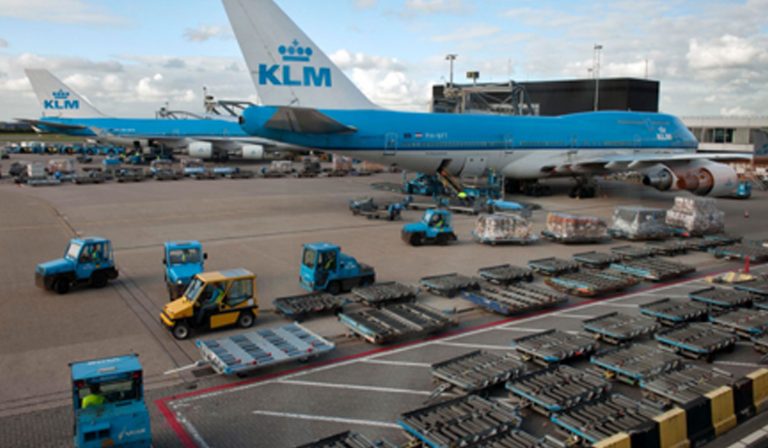
Schiphol and its partners are conducting a study on the possibility for ground handlers to share their vehicles and equipment. Sharing reduces the movements and the amount of ground handling equipment at aprons, such as stairs and baggage carts, and less material is left on the platforms. This situation reduces the likelihood of safety occurrences on the ground. A pilot has been performed with passengers’ stairs, Powerstows and conveyor belts on a few stands at the D-pier. The sharing of ground equipment and vehicles is part of the tender issued by Schiphol.
-
4. Deviations by ground handling staff
ISMS partners have investigated the reasons why ground personnel on platforms and service roads do not always comply with the rules and regulations. This research demonstrates several factors at play. To improve this situation, we have now implemented measures that were feasible at short notice.
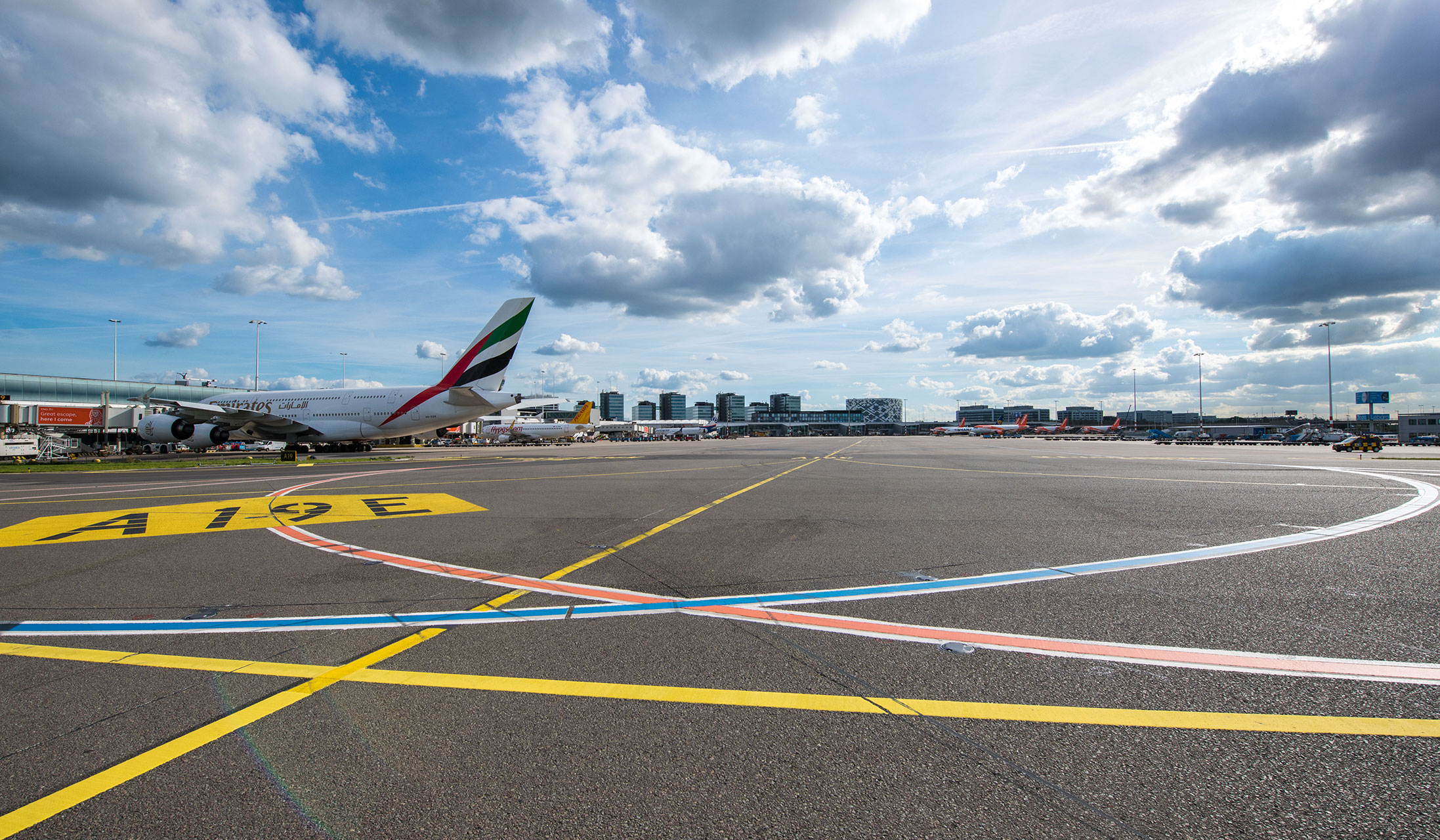
Line markings and pedestrian crosswalks have been improved, and broken lights have been replaced. The Schiphol rules are updated and enforced, and the sanctioning time is shortened. The Basic training Safety & Security has been improved and is an eLearning with an annual recurrent training.The lines of sight for traffic are improved on a few crossings at airside. Together with ground handlers, integral safety campaigns are organised.
This year, most ground service equipment has received a system that requires logging in with a card before the vehicle can be operated, and furthermore, a large part of the ground service equipment has been equipped with speed limiters. KLM has started a large safety awareness campaign to ensure more awareness on reasons for procedures and knowledge.Study
01MAR2019Planning
Implementation
31DEC2029Evaluation
36, 25, -
12. Follow the Greens
Schiphol and Air Traffic Control the Netherlands (LVNL) are researching the feasibility of a ‘Follow the Greens’ taxiway system. These are a set of sequenced green lights that guides pilots along the assigned taxi route. This visual aid eliminates the need for pilots to consult maps, reduces workload for ground controllers and relieves stress on ground frequencies. It will improve coordination and reduces the likelihood of on-ground safety occurrences and runway incursions.
Study
01JUN2026Planning
Implementation
Evaluation
36, 25, -
15. Increase number of aircraft parking positions (by building a new pier)
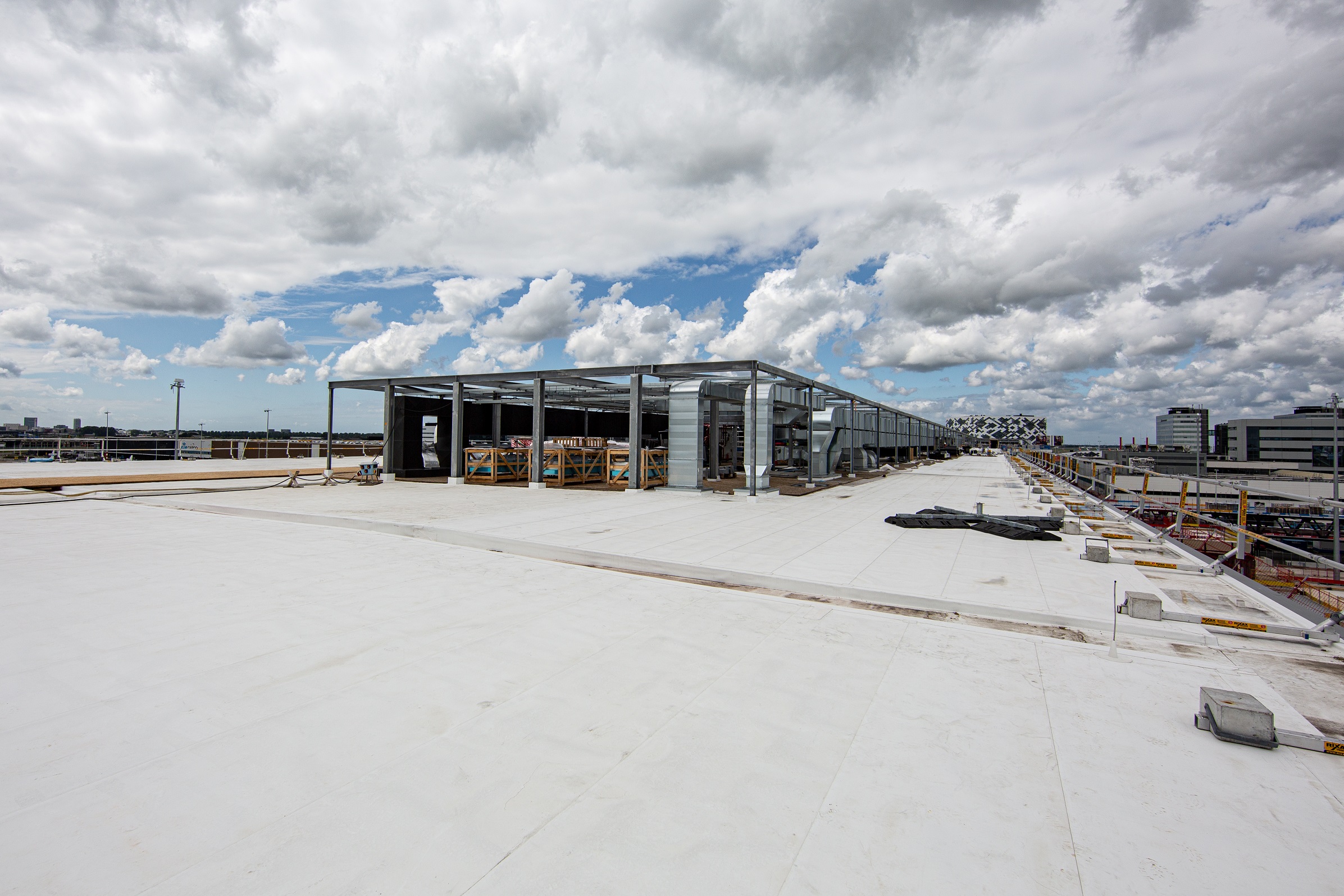
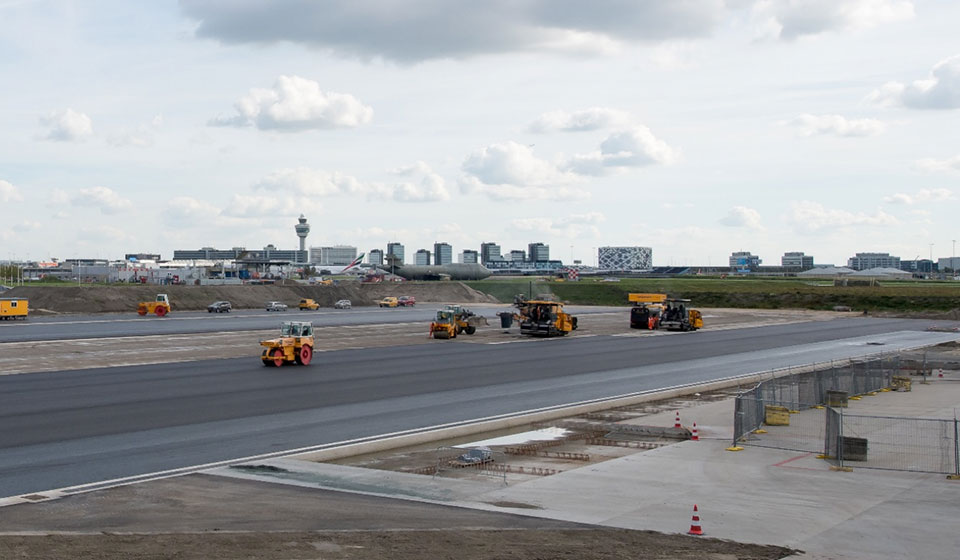
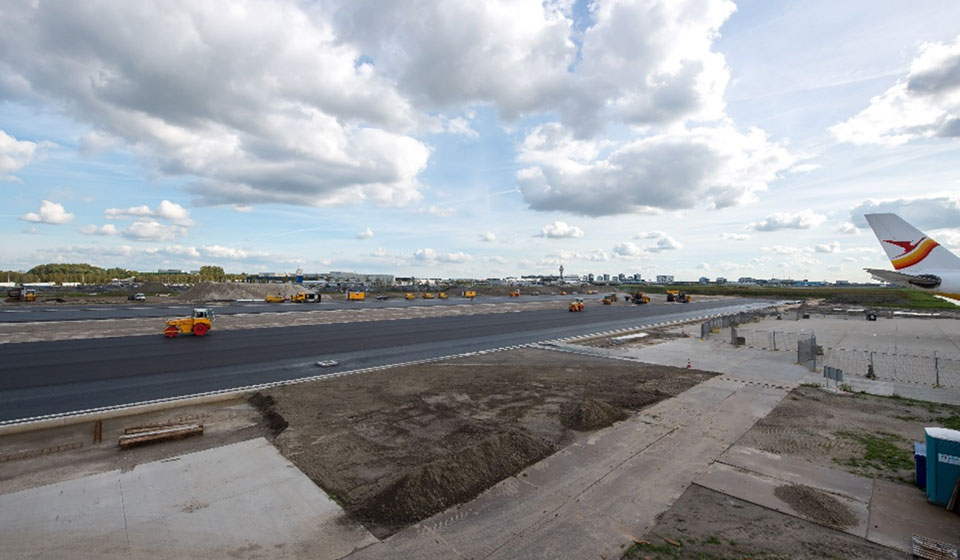
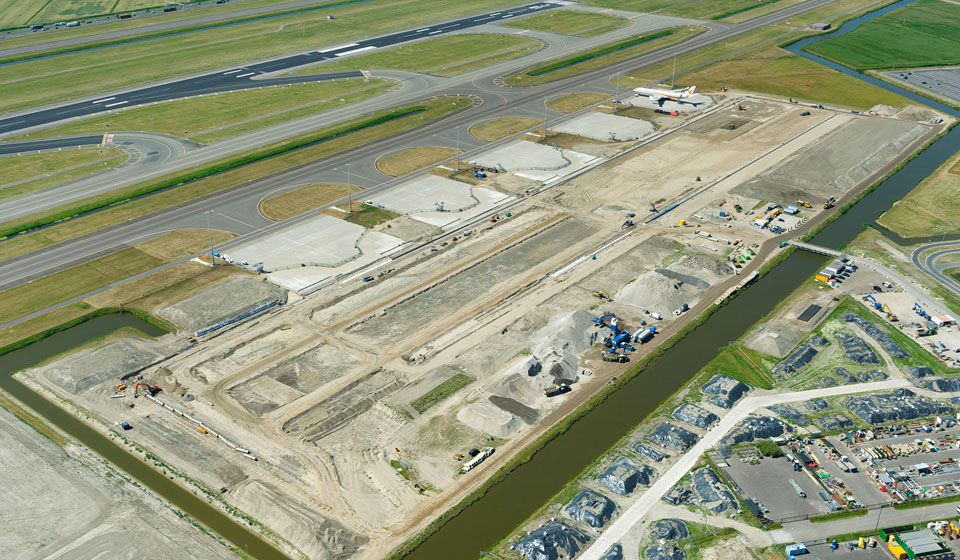
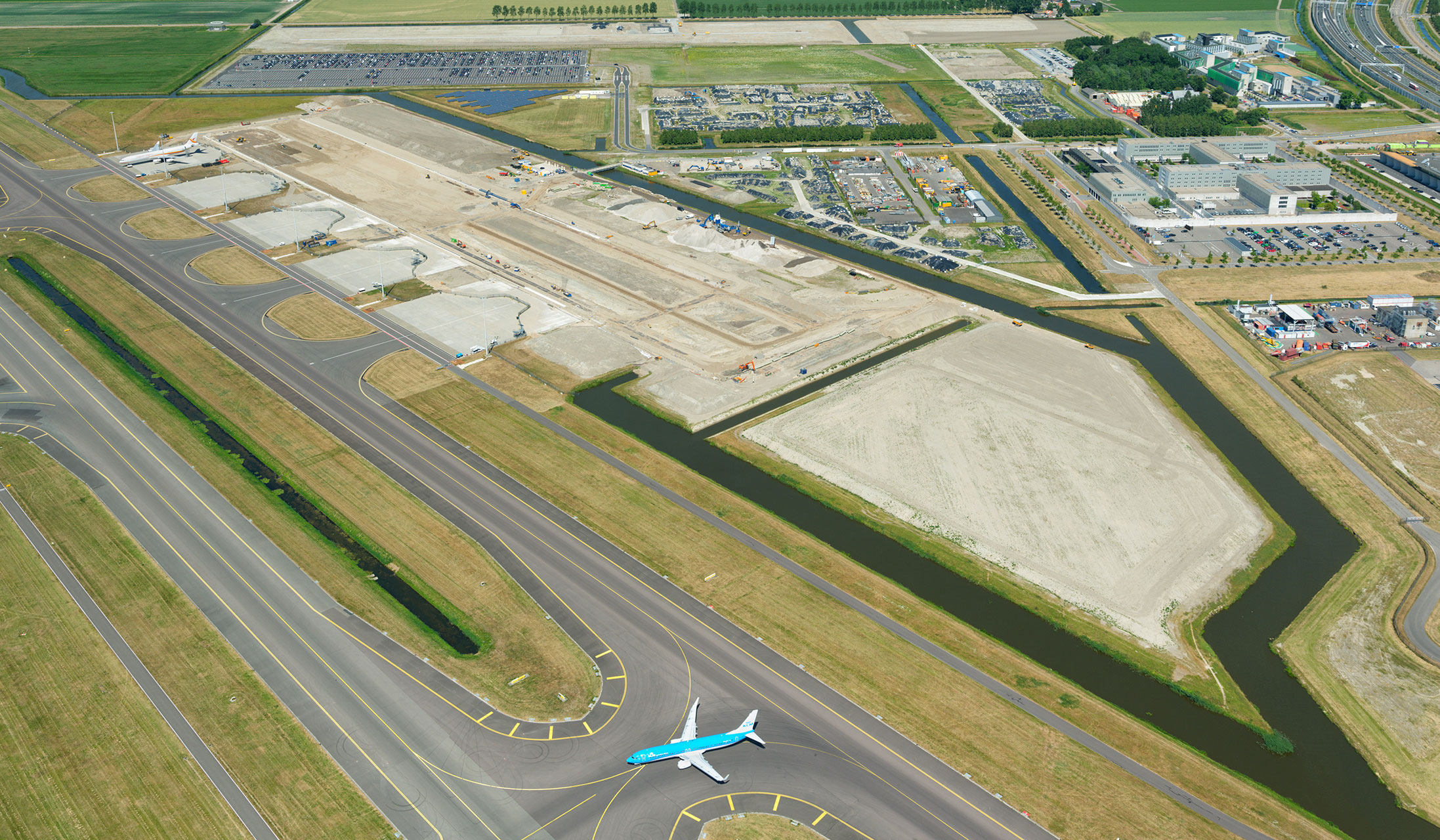
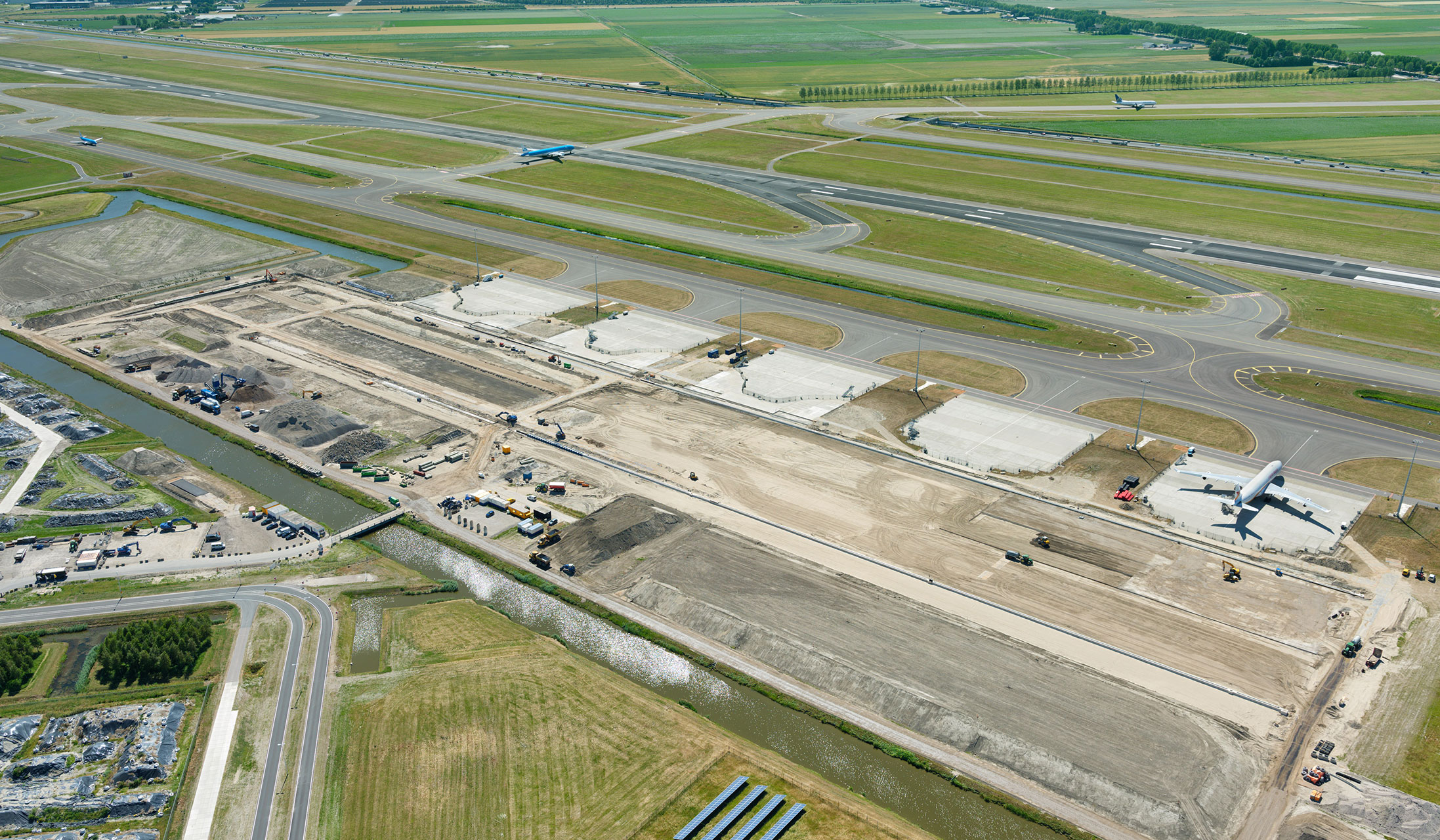
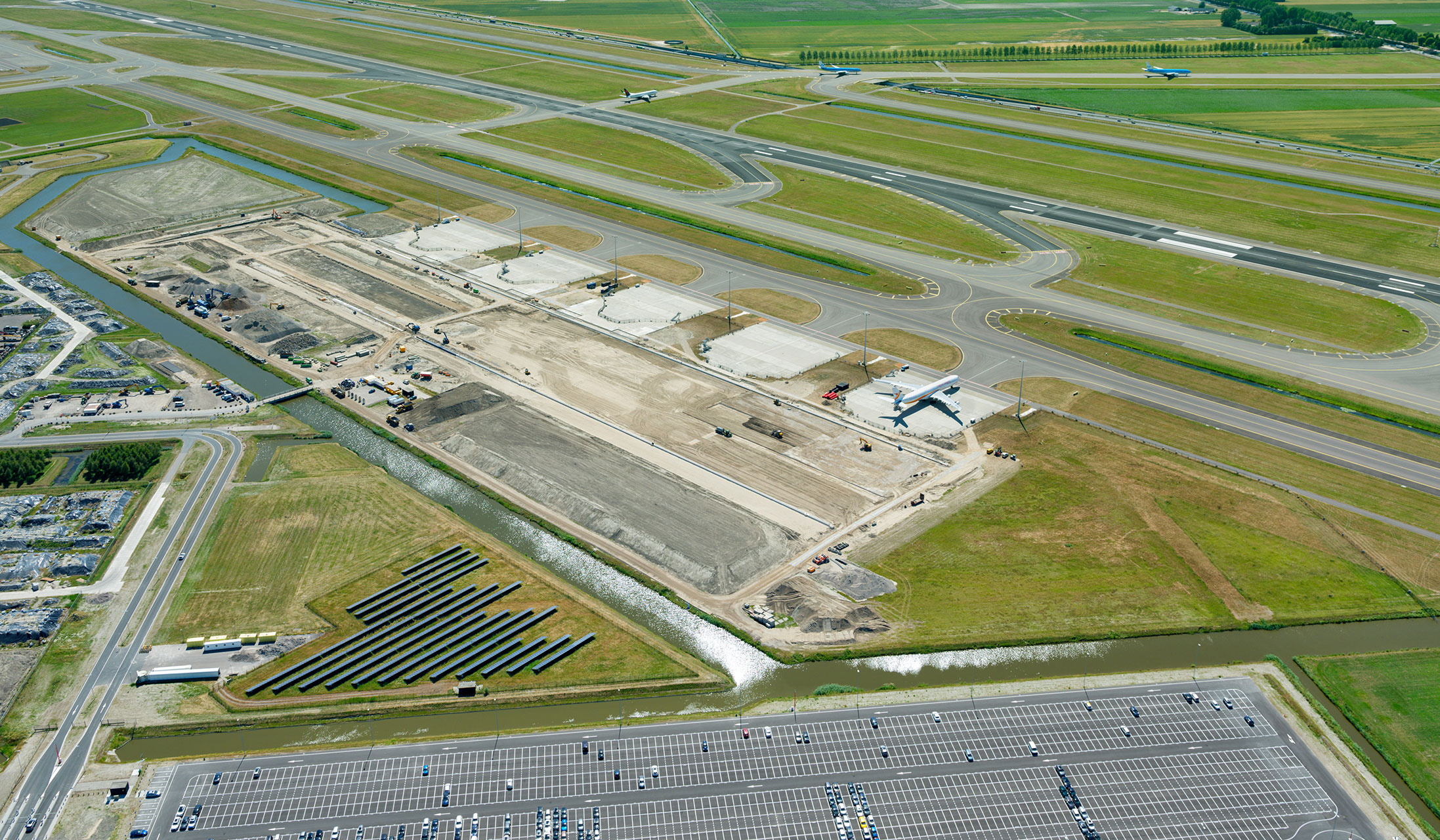
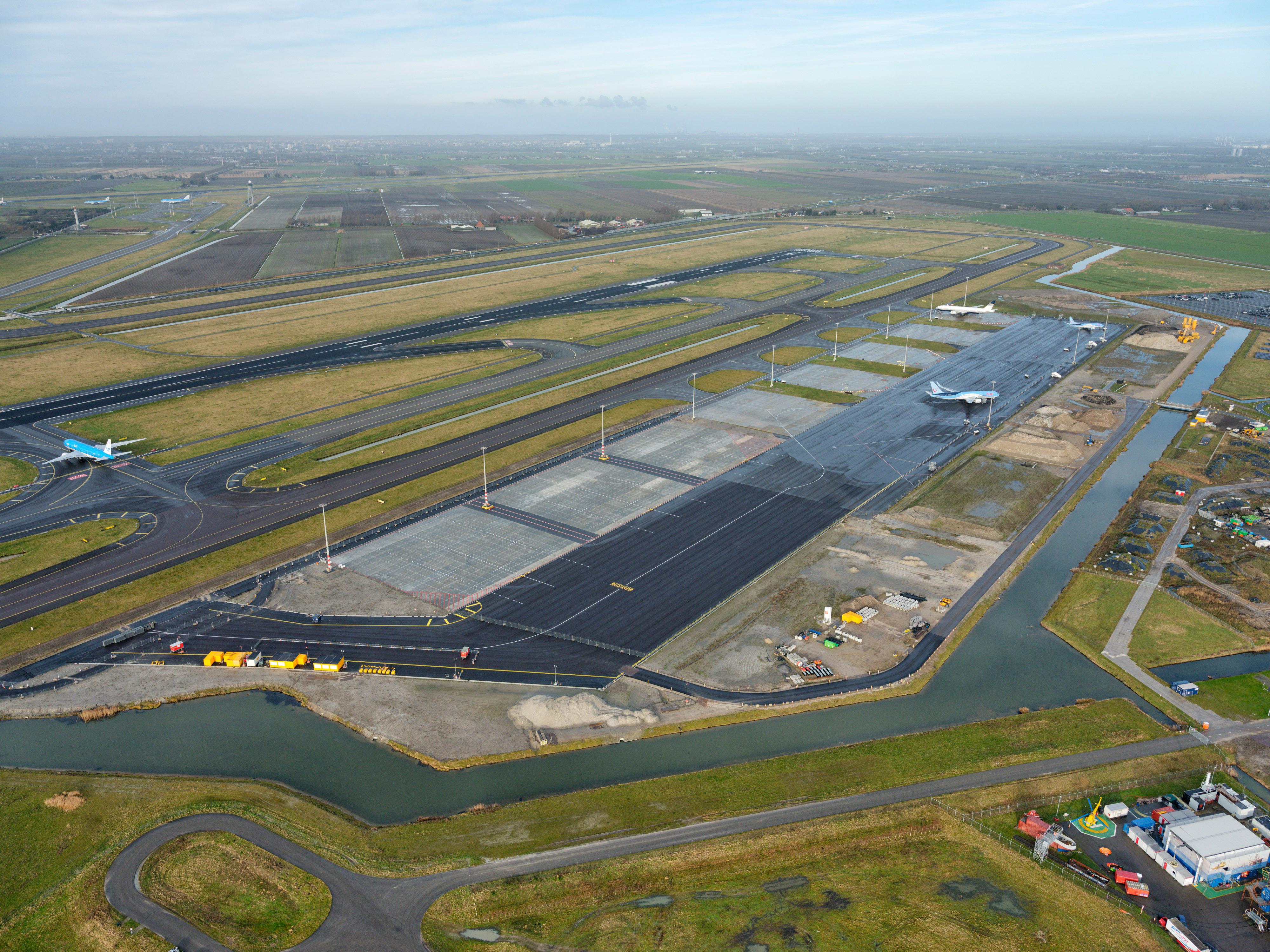
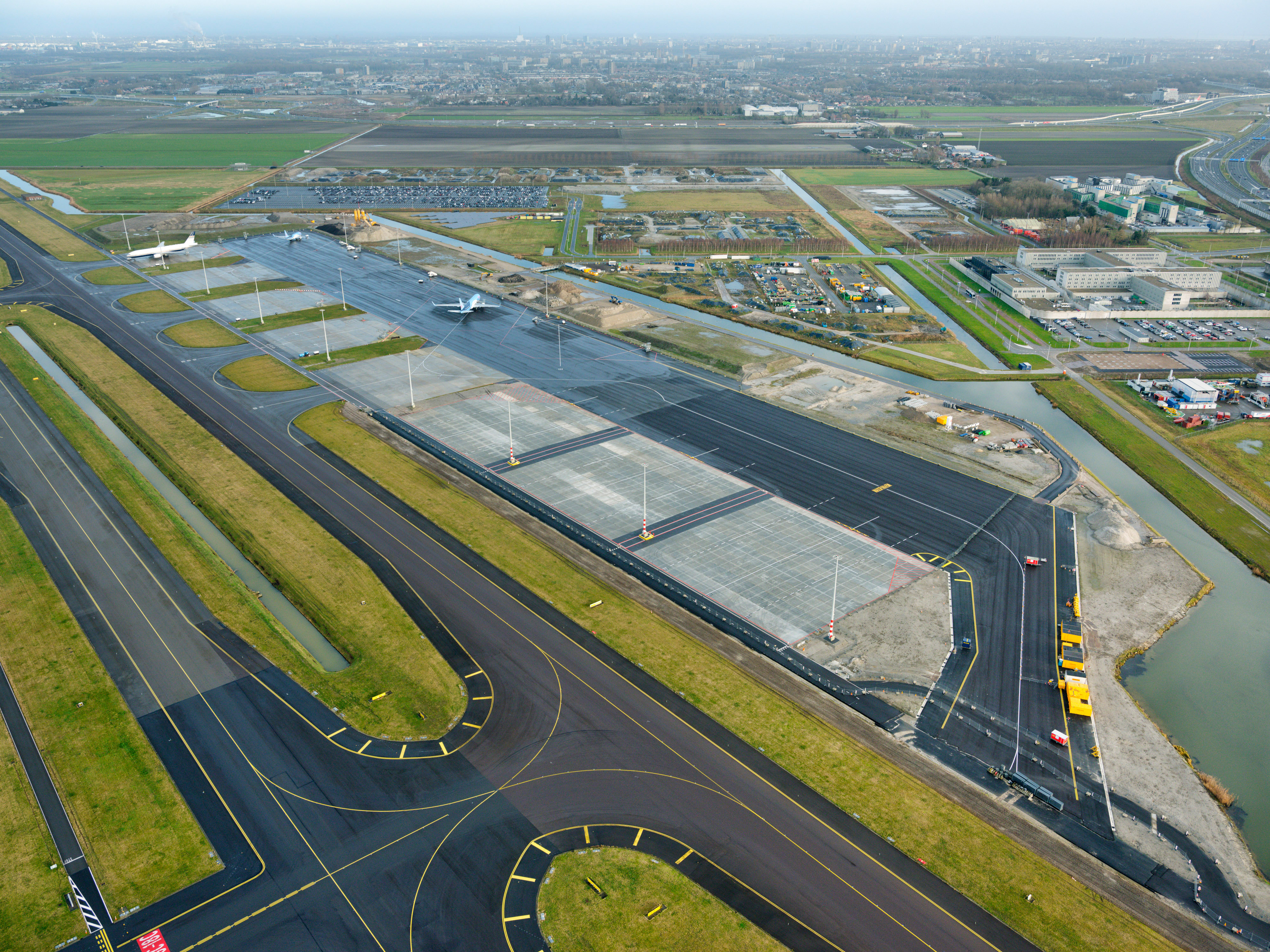
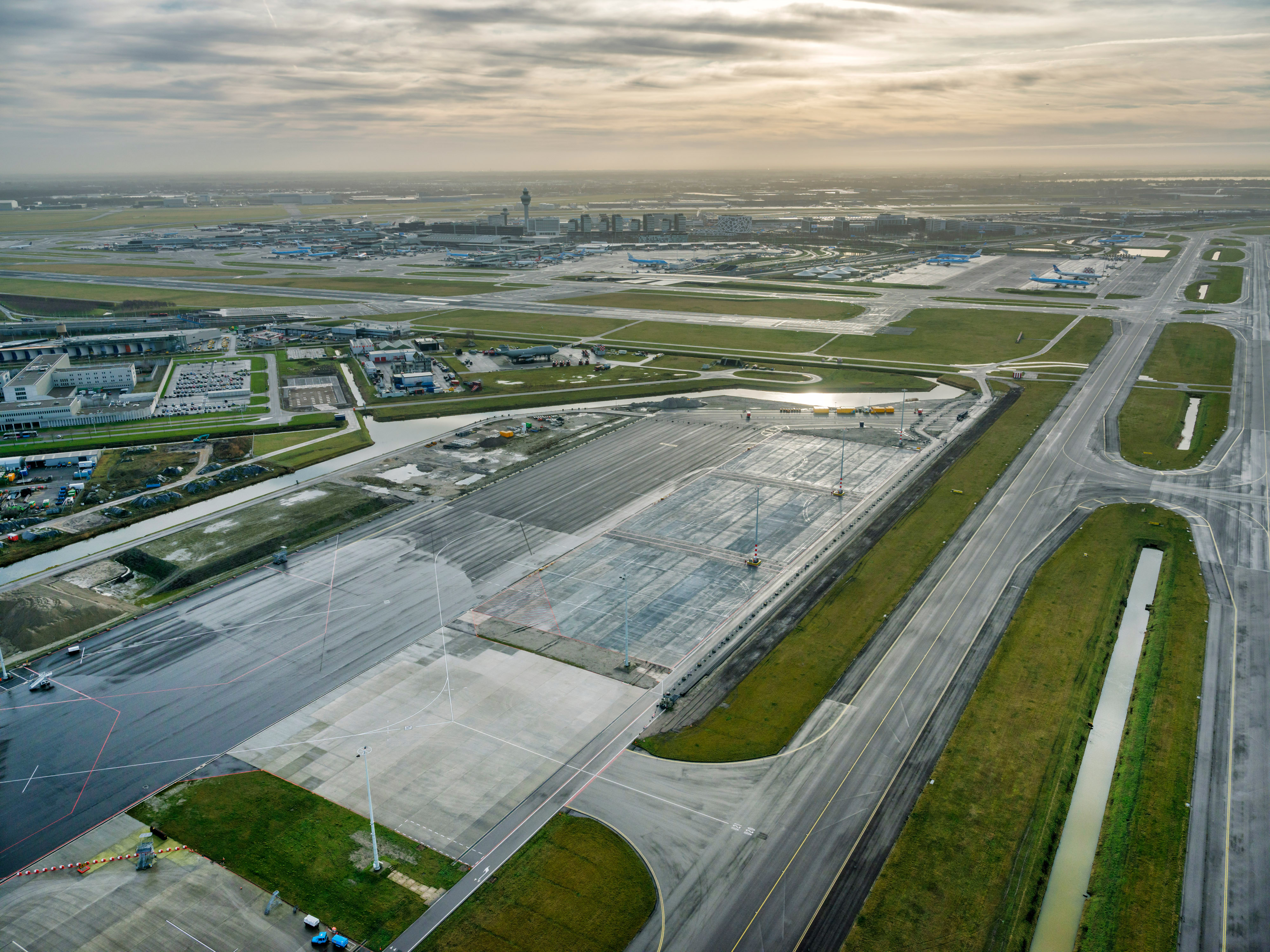
Schiphol is constructing a new pier with parking positions for both widebody and narrowbody aircraft. The new gates can accommodate 3 widebody and 5 narrowbody aircraft, or 11 narrowbody aircraft. The A-pier is located in the southwestern part of the airport, next to the Kaagbaan (06/24). The new pier increases gate capacity and relieves gate planning. As a result, the pressure on ground operations decreases, reducing the likelihood of ground safety incidents. The completion of the pier is also important to create sufficient capacity that allows Schiphol to renovate or remodel other piers.
Study
Planning
01JAN2017Implementation
Evaluation
36, 25, -
-
16. Completion dual taxiway system
Schiphol is equipped with a circumferential double-lane taxiway system, except for the current Quebec taxiway. Schiphol and its partners will increase operational predictability, uniformity and ground capacity by doubling the Quebec taxiway. This will reduce the likelihood of on-ground safety occurrences. In 2021, the partial doubling was completed, and a new viaduct was put into operation. At this stage, the demolition of several landside buildings and the removal of a platform on airside have begun to make room for the new layout of the dual taxiway system. The rest of the taxiway system will be completed by the end of 2027.
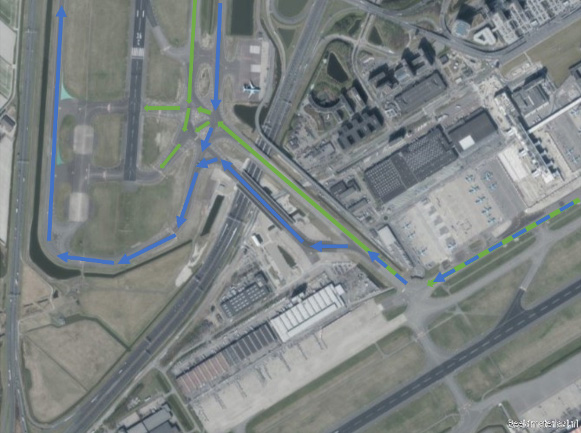
Less congestion in SW corner after splitting departure flows (for runway 36L and 36C)
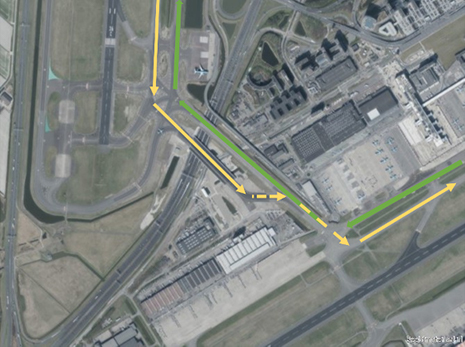
Smaller area of two way traffic reduces waiting times for opposite traffic
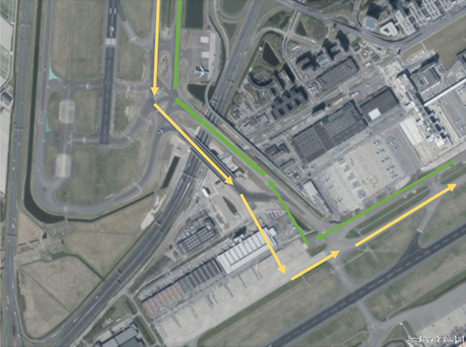
Situation after phase 1B and phase 2
Study
Planning
18SEP2018Implementation
01DEC2027Evaluation
36, 25, -
22. Sharing ground equipment and vehicles
Schiphol and its partners are conducting a study on the possibility for ground handlers to share their vehicles and equipment. Sharing reduces the movements and the amount of ground handling equipment at aprons, such as stairs and baggage carts, and less material is left on the platforms. This situation reduces the likelihood of safety occurrences on the ground. A pilot has been performed with passengers’ stairs, Powerstows and conveyor belts on a few stands at the D-pier. The sharing of ground equipment and vehicles is part of the tender issued by Schiphol.
Study
Planning
Implementation
Evaluation
36, 25, -
24. Colocation towing movement and ground control
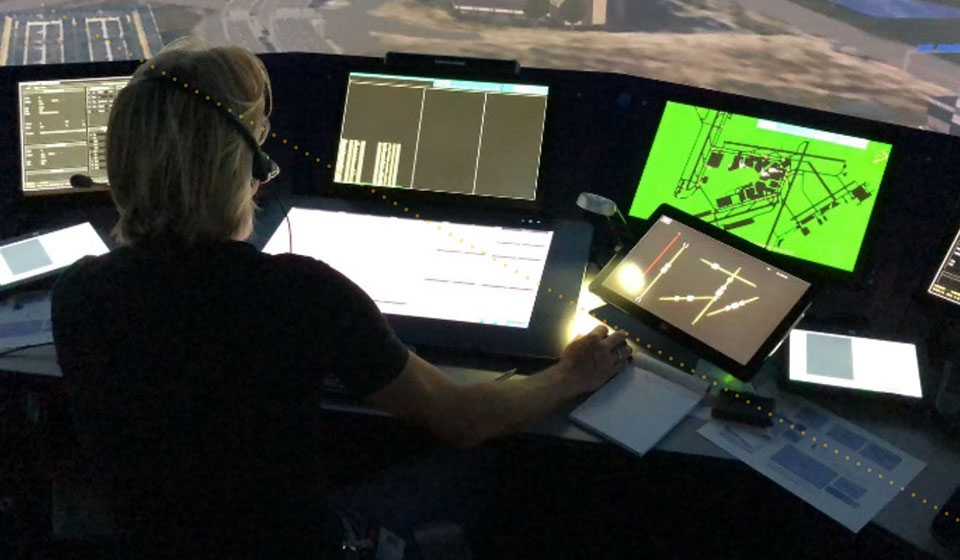
Air Traffic Control the Netherlands (LVNL) and Schiphol consider how to move towing movement control to the operation room in the Tower with ground control in order to enhance communication and coordination. This will reduce the likelihood of safety occurrences on the ground. LVNL will take over the task tow control from Schiphol. Implementation is planned before 2030.
Study
31DEC2020Planning
Implementation
31DEC2029Evaluation
36, 25, -
27. Last minute runway combination changes and complexity of changes in runway combinations
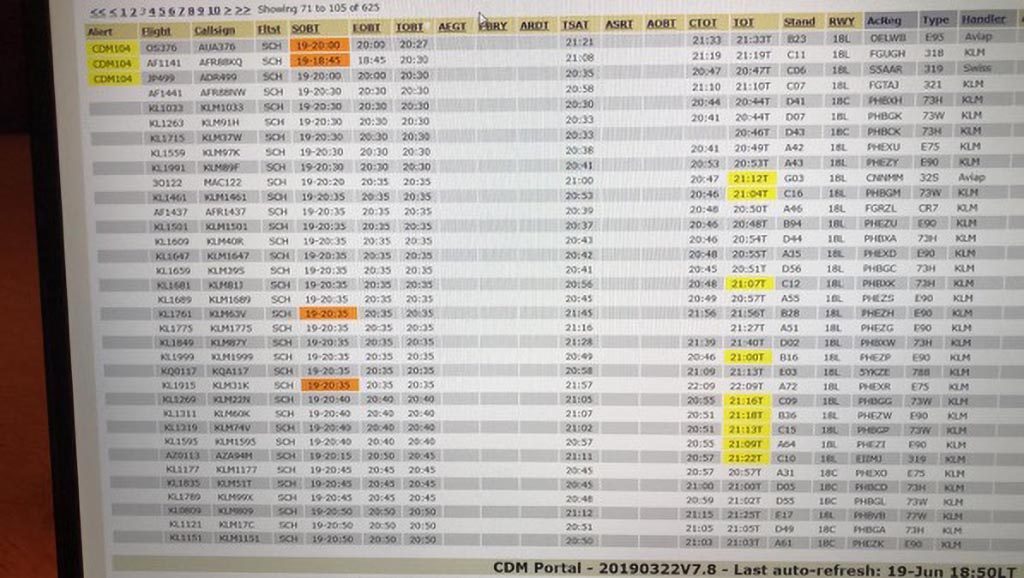
Runway combination changes that take place at the last minute may cause a disruption to the expected flight handling process, both for pilots and air traffic controllers. Air Traffic Control the Netherlands (LVNL) and Schiphol have developed measures to further reduce the number of last-minute runway changes, and the associated risks, in order to prevent air and ground safety incidents. For instance, we maintain landing runways when an aircraft is in the Terminal Manoeuvring Area (TMA) Schiphol; in addition, we use two departure runways when needed for a more stable traffic flow. We have also developed measures to improve the predictability of runway use and traffic flows using improved planning systems such as Arrival Management and Collaborative Decision Making. The percentage of last-minute runway combination changes is being monitored closely. The Schiphol Airport Operations Centre (APOC) is in use from June 2021 on.
 Study
Study
20JUN2019Planning
Implementation
31DEC2026Evaluation
36, 25, -
39. Risk reduction for docking of aircraft
ISMS partners jointly investigated an incident in which a towed aircraft collided with the passenger bridge on a stand. Based upon this investigation a system is being developed so that when parking a towed aircraft, it is easier to see exactly where to stop.
It has been decided to use the Advanced Visual Docking Guidance System as an additional verification tool for towtruck drivers, alongside the existing radio communication with the Apron Controller, thereby replacing the previous verification via the Airport Community App.
Study
08DEC2025Planning
Implementation
01JUN2026Evaluation
36, 25, -
41. Improve pedestrian safety
ISMS partners jointly investigated an incident in which an employee was severely injured after being hit by an Ambulift (a so called ‘Bulmor’) vehicle.
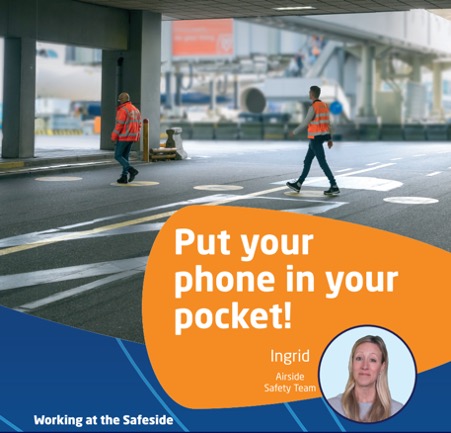
After the first investigation results, an awareness campaign was launched for improving the pedestrian safety at airside. A temporary Taskforce defined risk reduction actions to improve pedestrian safety at Airside. These measures include safer routes, improving pedestrian infrastructure and behaviour, and increasing enforcement.
Safer walking routes have been created through the terminal, which means that fewer pedestrians have to cross on airside. The use of these walking routes has been supported by a campaign. There is also more enforcement on pedestrian behaviour, such as the mandatory use of pedestrian paths and yellow dots to cross the road.
In addition, work is being done to improve the pedestrian infrastructure and the behaviour of employees on airside.
 Study
Study
02MAR2026Planning
Implementation
Evaluation
36, 25, -
42. Pushback Support Tool
The pushback process involves close collaboration between various organizations and operators, each following their own procedures. To help pushback drivers follow the correct pushback procedure according to the instructions given by the Ground Controller, Schiphol, LVNL and Ground Handlers are exploring a new tool called the Pushback Support Tool. This tool will be implemented on a tablet, which will be placed in the pushback truck’s cabin.
The main goal of the Pushback Support Tool is to support pushback drivers in performing their tasks safely and accurately. This is seen as a promising way to reduce risks during the pushback process.
Study
26MAY2025Planning
31DEC2027Implementation
Evaluation
36, 25, -
47. Stop bar 24 hours
A stop bar is a row of red lights in the pavement of a runway or taxiway at specific points where airplanes and/or vehicles must stop. It shows pilots and vehicle drivers where they must wait before crossing or entering a runway. While the stop bar is illuminated, airplanes and vehicles must not proceed. If necessary, air traffic control can turn off the stop bar when it is safe to proceed.
In the ‘Stop bar 24 hours’ concept, these lights are used throughout the day and in all weather conditions to protect the runways. An initial analysis by Schiphol and its partners suggests that this measure could be highly effective in reducing the risk of accidents on runways. Therefore, further research is being conducted to assess the feasibility of implementing this measure.
Study
Planning
Implementation
Evaluation
36, 25, -
50. Display of “STOP” on inactive docking guidance systems
Schiphol and its partners are currently implementing a new procedure on all docking guidance systems in which the word “STOP” is displayed on non-active docking systems.
This will provide guidance to pilots on what is expected from them when they arrive at the gate where docking is not possible for any reason. This will help reduce the likelihood of self-dockings thereby reducing the risk in the docking process.
Study
03FEB2025Planning
Implementation
31DEC2025Evaluation
36, 25, -
53. Safe ground handling A32xneo
KLM and Transavia are replacing their Boeing 737-fleet for Airbus A320neo and A321neo aircraft. These new aircraft require more ground handling activities. To manage the risks, measures are being taken to create more handling areas, storage and use of containers. The clean/standard VOP design has now been revisited to adapt for the A32xneo, unused housing at D3 and D7 has been removed to make room for approximately six more common use GSE parking spots and the introduction of left-hand side fueling has now been implemented.
Study
01JUN2026Planning
Implementation
Evaluation
36, 25, -
54. Relocating the PAPI and aiming point for Runway 22
Based on investigations into a short landing by an Airbus A330-300 on Runway 22, the Precision Approach Path Indicator (PAPI) and Aiming Point on Runway 22 will be relocated. This project is currently in planning, with the aim to implement the relocations during the major overhaul of Runway 04/22 in 2027.
Until that time Runway 22 will continue to be used for large aircraft. Independent investigation by NLR has shown that continued runway use is safe, also for large aircraft.
Study
Planning
31DEC2026Implementation
Evaluation
36, 25, -
55. Renaming taxiways
At Schiphol 45% of deviations from taxi clearances happen at the locations Zulu (A26/A27/ A28), A29 and A21/A22. The most common underlying root cause considers the fact that taxiways in different directions can have the same name for flight crew who arrive at a taxiway intersection combined with the complex layout of the taxi tracks at these junctions.
Schiphol and LVNL will therefore rename the taxiways at these locations according to the following design:
 Study
Study
Planning
30JUN2029Implementation
Evaluation
36, 25, -
56. Reduce the number of ground handlers at Schiphol
On the 30th of April 2024 the Minister of Infrastructure and Water Management issued a decree that limits the number of ground handling organisations (GHOs) at Schiphol airport to three. According to the decree, the Minister’s restriction decision aims to contribute to resolving the inefficient functioning of the ground handling market, reducing staff shortages among ground handling companies, preventing aircraft handling from being delayed, improving the safe execution of work processes and improving the terms and conditions of employment of ground handling staff.
Reducing competitive pressure is stated to be a necessary condition for this. The decree applies only to apron and baggage handling services and does not apply to self-handling, cargo handling, or other services such as fueling of aircraft. In accordance with the applicable regulations, the selection of the three GHOs is done by Schiphol Nederland BV (SNBV), as airport operator, via a tender procedure. The tender has now been published.
Study
Planning
01APR2027Implementation
Evaluation
36, 25, -
57. Safe transition to the Regulated Ground Market (RGM)
The transition process from the current situation to the regulated groundhandling market increases safety risks during the transition period. To mitigate these risks, guarantee of job and employment conditions will be put in the tender criteria. Furthermore, a matching tool will be made, easy Schiphol pass application will be facilitated and there will be a best efforts obligation in the tender criteria.
Study
Planning
Implementation
28MAR2027Evaluation
36, 25, -
58. Safety measures Risk Reduction Action Plan aircraft damage
The number of incidents with aircraft damage has been increasing at Schiphol. To mitigate risks actions have been proposed. Handlers will emphasize the team leader’s task to coordinate all handling activities on the stand. Furthermore, Schiphol will appoint a pier caretaker, GSE that is supposed to dock with the aircraft will be equipped with a collision avoidance system (CAS) and the team leader will explicitly emphasize the safety risks and safety instructions in a briefing before each flight.
Study
31AUG2026Planning
Implementation
Evaluation
36, 25,
-
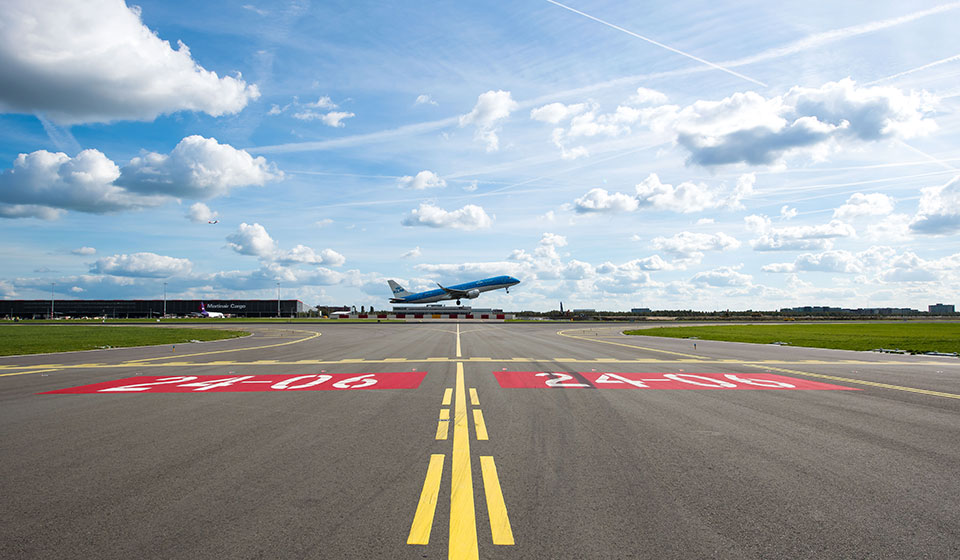
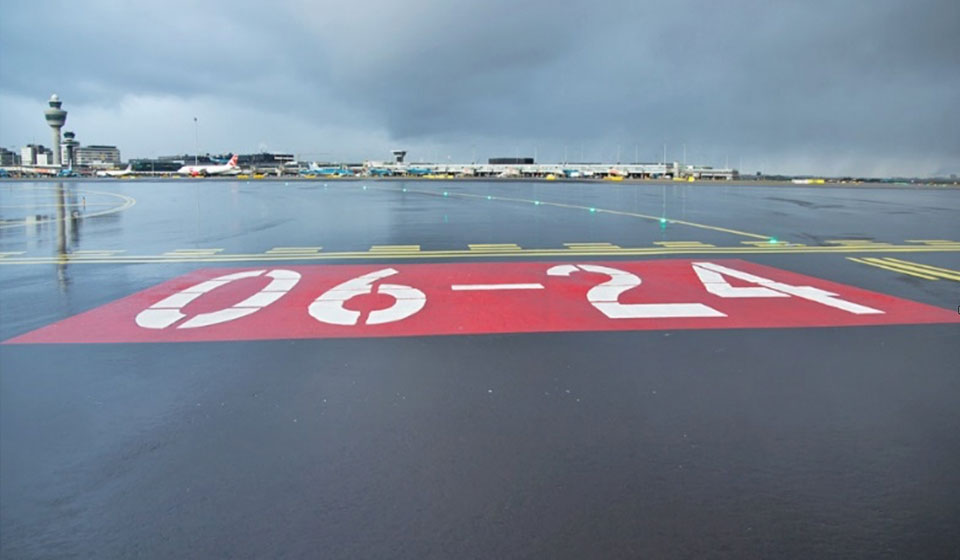
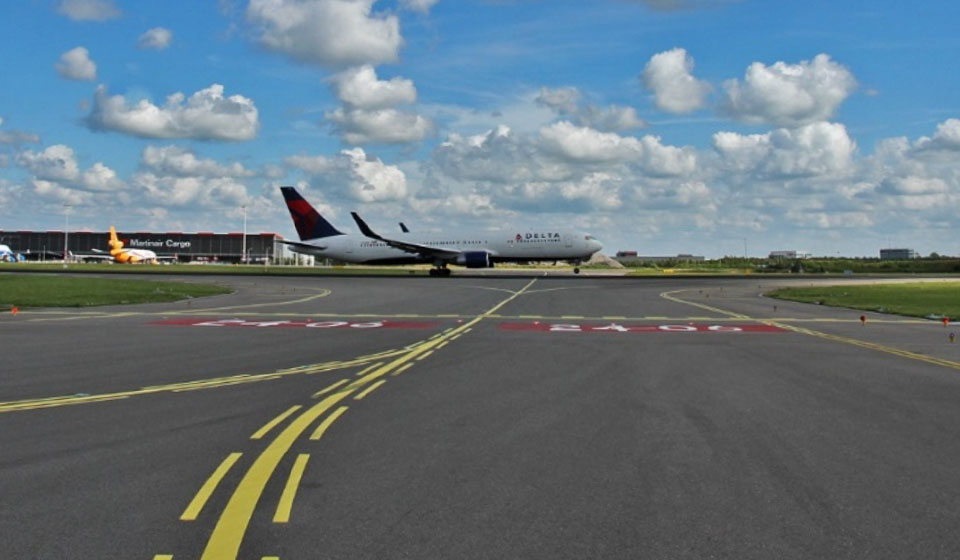
29. Crossing runway 06-24 (Kaagbaan)
When taxiing to or from the Sierra platform, aircraft cross runway 06/24 (Kaagbaan). Schiphol and its partners have researched the ways that this crossing can be made safer to mitigate the risk of possible runway incursions. We also looked at alternative taxi routes to and from the Sierra platform.
After research, it is decided that aircraft will use a new intersection at Sierra 1. Because aircraft no longer cross at a ‘high energy point’, the risk of runway incursions will decrease.
The newly built intersection has been taken into use at the beginning of 2025. An evaluation of this measure will be performed in 2026.
Study
20SEP2019Planning
Implementation
06JAN2025Evaluation
36, 25, -
-
40. License to operate
Schiphol consulted its partners in order to create together a License to Operate (LTO) for Generic Ground Handling Service Providers at the airport. The LTO defines the minimum safety, quality, and operating standards for the ground handling operation. The content was drafted with the involvement of Ground Handling Service Providers, contributing to the shared goals: a safe and healthy workplace for all employees, reliable and excellent performance and sustainable operations. As a result, a level playing field is achieved and clarity is offered on the minimum quality level for ground handling. As per January 1st, 2023 the LTO is effective. The LTO has been updated for 2024. The requirements have been worked out more clearly and it has been ensured that all requirements are measurable. In 2025, the effectivity of the LtO will be evaluated. Any recommendations resulting from this will be included in the next version of the LtO.
The requirements aimed at participating in ISMS and at securing the language proficiency have now been implemented. The implementation of the use of Schiphol assets is still ongoing.
Study
Planning
Implementation
01JAN2023Evaluation
02MAR202636, 25, -
52. Handling A321 on short stands
The Airbus A321 had limited maneuverability for Ground Service Equipment behind the tail of the aircraft on stands D16-D28 and C14, causing ground handling risks. To create more space, the A321’s stop position was moved to a more forward position and the red apron safety line has now been relocated 2,5m backward.
Study
Planning
Implementation
30JUN2025Evaluation
07SEP202636, 25,
-
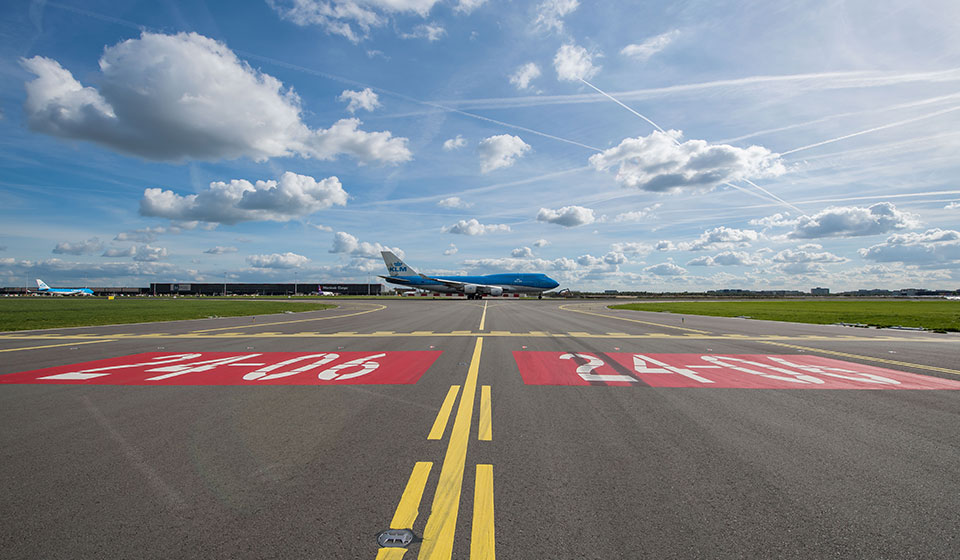
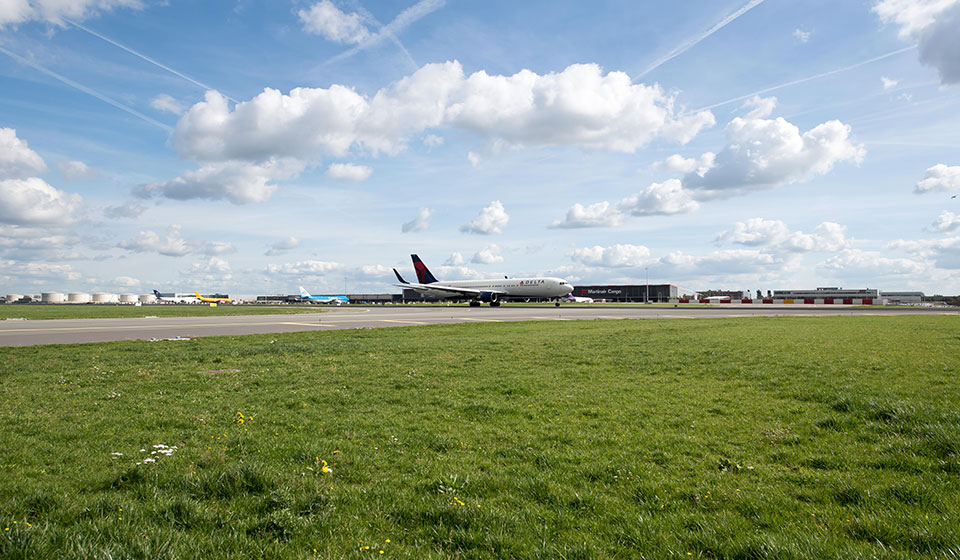
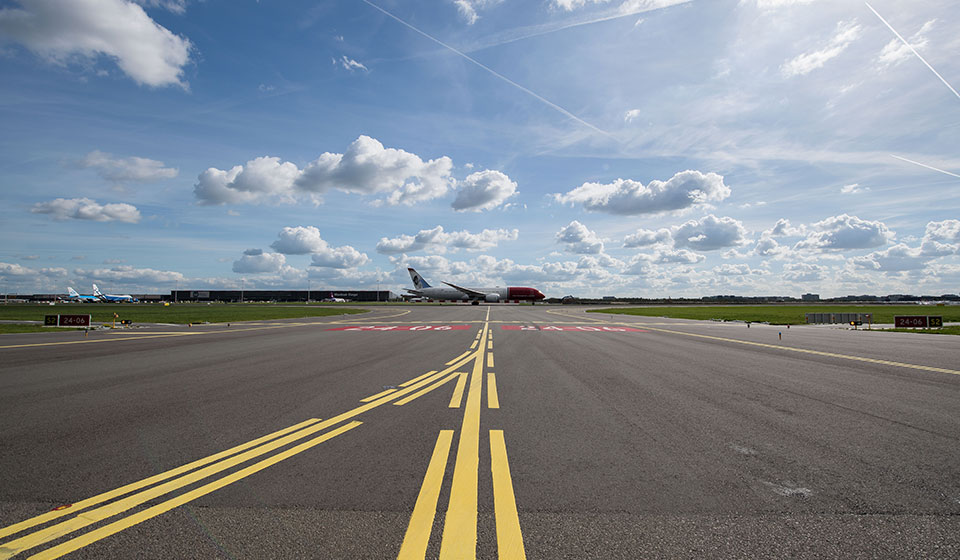
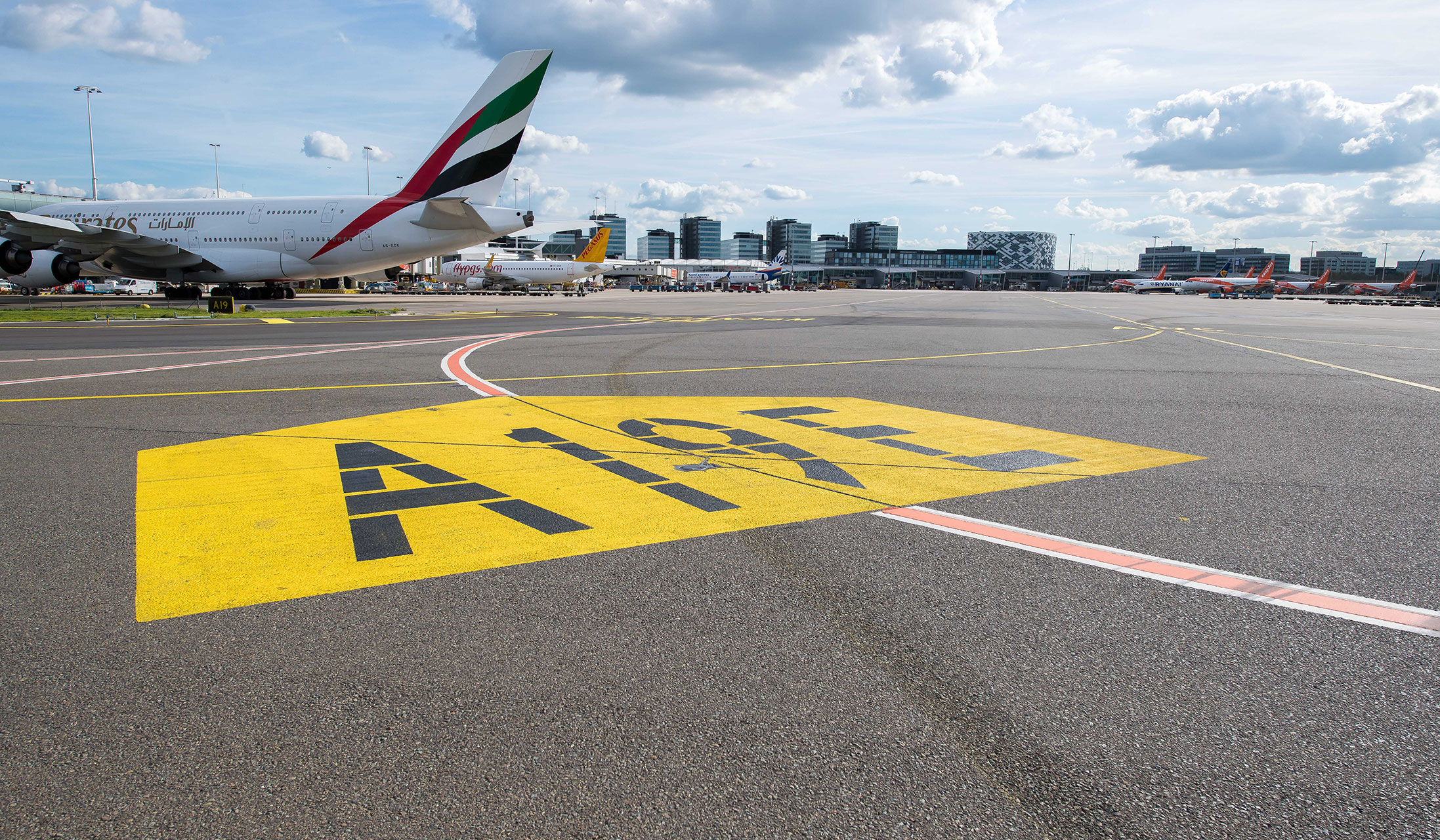
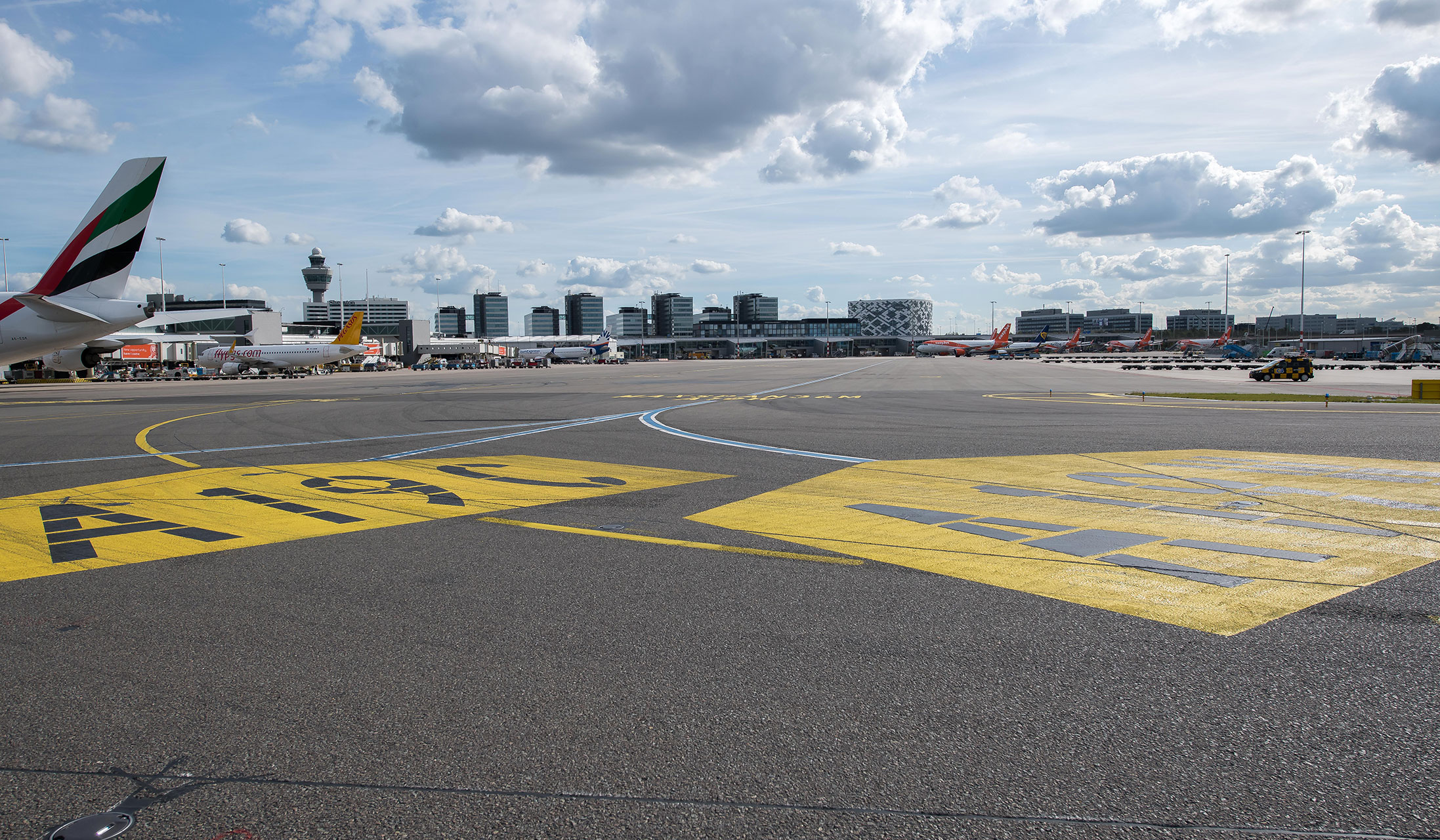
1. Uniform platform extension from 5 to 9 parking positions
The Uniform platform was expanded from 5 to 9 parking spaces by Schiphol and its partners in order to create more parking spots for wide body aircraft.
The evaluation established that this has reduced the number of tows from and to Schiphol-Oost, leading to less crossings of the Aalsmeerbaan (18L/36R) Runway and the Schiphol-Oostbaan (04/22) Runway.
Study
Planning
26MAR2018Implementation
Evaluation
15APR202036, 25, -
-
2. Improved co-ordination between runway controller and tower assistant
Co-ordination between the runway controller and tower assistant is an explicit part of new employee training. Furthermore, co-ordination is included in annually-recurring training as well. This reduces the likelihood of runway incursions. The evaluation established that these modifications are implemented and used correctly.
Study
Planning
01JAN2017Implementation
01JAN2018Evaluation
05MAR202136, 25, -
3. Revising naming of taxiways
Schiphol and its partners improved the names of specific taxiways. With this revised nomenclature the consistency of the taxiway system has been improved. This reduces the likelihood of errors and misunderstandings due to similar/confusing naming conventions.
Evaluation showed that the revision was correctly implemented and nomenclature is now consistent and thus safer than before.
Study
Planning
Implementation
31DEC2023Evaluation
09MAY202536, 25, -
5. Converging runway use
A missed approach is a standard procedure. An aircraft can come into conflict with departing air traffic when it must execute a missed approach while a converging departure runway is in use. Air Traffic Control the Netherlands (LVNL) and its partners have been investigating how they can further increase the safety of this procedure.
Timing appears to be an effective measure to reduce the risk of converging approach and take-off operations. By ensuring there is adequate time between these operations we can further decrease the risk of conflicts occurring.
It was decided to implement timing for all converging runways, taking into account the geometry for each of the converging runway combinations. Air Traffic Control the Netherlands (LVNL) developed dedicated training for the runway controllers focusing both on conflict prevention and resolution.
Evaluation showed that the share of approaches in the critical area has reduced significantly. The associated risk has been substantially reduced but was not fully mitigated. Measure is closed, with additional internal follow-up by LVNL and actions by partner airlines to improve pilot response on takeoff roll initiation.
Study
31MAR2020Planning
Implementation
01AUG2022Evaluation
08DEC202536, 25, -
6. Fixed connection to fuel system
Schiphol and its partners introduce a fixed connection to the fuel system at the Delta and Echo buffer, which reduces the number of movements of tank trucks to these positions. This is likely to reduce the risk of on-ground safety occurrences. The evaluation established that this system is in place and used for all refuelling at the Delta and Echo buffer. Tank truck movements to these positions are thus no longer necessary.
Study
Planning
01SEP2017Implementation
15APR2018Evaluation
31DEC202036, 25, -
8. Navigation technology
The European Union is improving the use of European airspace under the project name ‘Single European Sky ATM Research’, or ‘SESAR’. As part of this project, approaches based on satellite technology (RNAV) are implemented at Schiphol. This allows aircraft to carry out an RNP Approach which involves using three-dimensional GPS navigation on the approach to a runway. As of 7 November 2019, an RNAV approach is possible for four runways at Schiphol. The navigation technology makes flight paths for approaching aircraft more predictable, which will reduce the likelihood of any in-flight safety incidents.
Study
Planning
01JUL2018Implementation
12AUG2021Evaluation
26MAY202536, 25, -
10. Increased upper limit of the Terminal Manoeuvring Area
The TMA is the airspace controlled above and around the airport by air traffic control. By taking this measure, we will utilise a standard method to enable the desired flight profiles. In this way, we will increase the predictability of the flight paths of approaching aircraft, and reduce the complexity of the airspace.
The evaluation concluded that the measure is implemented and has simplified, standardized, and formalized operation. The expected safety improvements have been realized.
Study
Planning
Implementation
31DEC2018Evaluation
27MAY202436, 25, -
11. Check pushback procedure online
Schiphol and its partners have developed and published a website that pushback drivers can easily consult for the standard procedures for pushback. This will reduce the risk of safety incidents during pushback manoeuvres. The first evaluation showed that more could be achieved from this measure by providing a device for each pushback driver on which they can consult the current pushback procedure. Evaluation of this measure showed more could be achieved with this new website.
This measure has now been fully implemented and has been evaluated twice, based on which, improvements have been proposed and will be implemented. Data shows a security improvement since the implementation of the website.Study
01JAN2019Planning
Implementation
01JUL2023Evaluation
13DEC202336, 25, -
13. Electronic flight strips
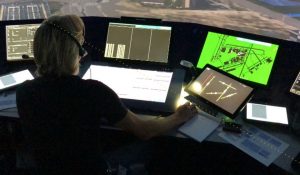
Air Traffic Control the Netherlands (LVNL) has successfully introduced electronic flight progress strips for air traffic controller workers. This digital system reduces the workload for air traffic controllers. In addition, this electronic method enables extra safety nets to be created. An evaluation of this measure established that the digital strips have been properly implemented and are being used.
 Study
Study
Planning
13OCT2016Implementation
30APR2019Evaluation
13DEC202336, 25, -
17. Ground handling adverse weather procedure
During adverse weather conditions, like thunderstorms and storm, or (heavy) fog, all ground handlers need a clear procedure. Schiphol and its partners have implemented a standard procedure that increased the predictability and uniformity of ground handling operations in order to reduce the likelihood of on-ground safety occurrences.
The evaluation of this measure showed that a standardized procedure for heavy wind and storm is in place. This addition to regulate ground handling activities during wind gusts in the handbook provides clarity and uniformity.
Study
Planning
01JAN2018Implementation
01JAN2018Evaluation
09MAY202536, 25, -
18. “Runway occupied” strip
Air Traffic Control the Netherlands (LVNL) is now using a ‘runway occupied’ strip in their procedures in both Tower Centre and Tower West whenever a runway is occupied by a bird control or another vehicle. This working procedure was introduced to prevent runway incursions. The evaluation established that the ‘runway occupied’ strip functions adequately and has helped to reduce runway incursions.
Study
Planning
Implementation
28NOV2017Evaluation
15APR202036, 25, -
19. Double guidance lines to the Bravo taxiway
Schiphol and its partners have applied additional guidance lines at the G/H-pier area to the Bravo taxiway. This will enable narrow-body aircraft to pass each other safely when taxiing from and to the G/H-pier. This reduces complexity and reduces the likelihood of on-ground safety occurrences. The evaluation established that the double guidance lines are in place and used when possible and beneficial (about 90% of the time). This resulted in less congestion on the taxiways and at the G-H pier area, and less workload for ground control.
Study
Planning
03APR2018Implementation
01JUN2018Evaluation
12JUN202036, 25, -
-
20. Double guidance lines to the Alpha taxiway
Schiphol and its partners have applied additional guidance lines at the G/H-pier area to the Alfa taxiway. This will enable narrow-body aircraft to pass each other safely while taxiing from and to the G/H-pier. This reduces complexity and reduces the likelihood of on-ground safety occurrences. The evaluation established that the double guidance lines are in place and used when possible and beneficial (about 90% of the time). This resulted in less congestion on the taxiways and at the G-H pier area, and less workload for ground control.
Study
Planning
03APR2018Implementation
01JUN2018Evaluation
12JUN202036, 25, -
-
21. Three ground controllers
During the day, there used to be one or two ground controllers in Tower Centre and one in Tower West near runway 18R/36L (Polderbaan). Air Traffic Control the Netherlands (LVNL) has added a third ground traffic controller to the crew at the Central Control Tower, depending on air traffic volumes. This reduces the workload of ground controllers and the likelihood of runway incursions and on-ground safety incidents.
The evaluation of the introduction of a third ground traffic controller showed that it indeed led to a reduction of the ground controller workload and did not introduce unacceptable safety risks.
Study
Planning
26MAR2018Implementation
01APR2020Evaluation
03FEB202536, 25, -
23. Redesign of work stations in the Control Tower
Air Traffic Control the Netherlands has redesigned work stations in the Tower. This allows air traffic controllers to work at positions that have the most favourable view over their areas of control, thereby reducing the likelihood of safety occurrences in the air and on the ground. It is established that the redesign of work stations in the Control Tower is implemented.
Study
Planning
30AUG2018Implementation
01JUL2019Evaluation
31DEC202336, 25, -
25. Routing between the Kilo platform and runway 22 (Schiphol-Oostbaan)
Schiphol and Air Traffic Control the Netherlands (LVNL) have created an unambiguous traffic flow to and from the Kilo platform at Schiphol East. This is effectuated by introducing a one-way traffic system and a safer routing for entering and leaving the Kilo platform. The evaluation established that this measure has helped to decrease runway incursions at this location.
Study
Planning
01JUL2017Implementation
01JUL2018Evaluation
15APR202036, 25, -
26. One-way traffic on the Alpha and Bravo taxiways
Schiphol and Air Traffic Control the Netherlands (LVNL) have applied standard practices for taxiing and towing on the Alfa and Bravo taxiways by introducing a one-way traffic system. The driving direction on the Alfa runway is now clockwise and the Bravo runway is anticlockwise. These standard routes will improve predictability of taxiing and towing movements, in order to reduce the likelihood of on-ground safety occurrences. The evaluation established that the standard routing is used, except where circumstances require another solution, e.g., during construction work. The objective of improving the predictability is met.
Study
Planning
Implementation
01JUN2018Evaluation
02OCT202036, 25, -
28. Intersection N2-E6 towards Runway 18L (Aalsmeerbaan)
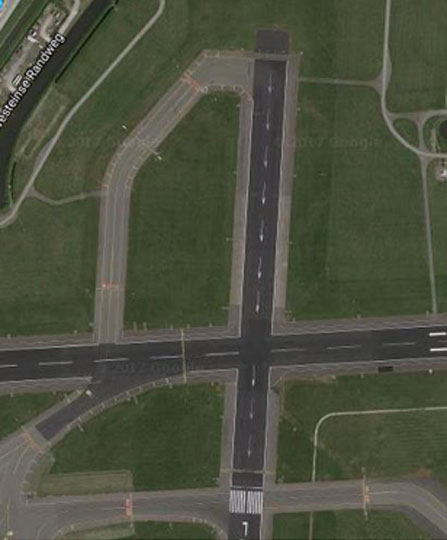
Aircraft following the routing to the beginning of runway 18L (Aalsmeerbaan) pass intersection N2/E6. At that point, the traffic crosses runway 09 (Buitenveldertbaan).
Schiphol and its partners constructed a runway stop bar in order to prevent aircraft that erroneously turn right from taxiing via the Buitenveldertbaan runway towards departing traffic. This will reduce the risk of runway incursions.
The results of the 2024 evaluation showed that the stop bar is correctly implemented and that the stop bar measure is effective in reducing the identified risks.

 Study
Study
01MAR2019Planning
Implementation
01JUL2022Evaluation
16SEP202436, 25, -
30. Reduction of marshalled towing risks
ISMS partners jointly investigated a safety incident in 2018, which happened between a towed aircraft and a marshaller in the field. As a result, Schiphol and its partners have already taken a number of further measures, such as tightening up the procedure, to reduce the risks of marshalled towing. The tow drivers are trained and qualified for the new 2021 standard. The manual has been changed with a clear instruction for tow drivers on the operational procedure. We have also reduced the need to marshal towing movements, thus reducing the risk of safety incidents with marshalled tows.
Evaluation has shown that marshalled tows hardly occur anymore. Implemented actions have made sure that the risks of both a collision between a marshaller and a tow and a runway incursion with a marshalled tow are almost eliminated.
Study
03DEC2018Planning
20JUN2019Implementation
31DEC2022Evaluation
08DEC202536, 25, -
31. Reduced risk of misaligned take-offs
In 2016, an Embraer departed from the edge of the Kaagbaan (runway 24). Directly after the incident, Schiphol extended the taxiway centre line marking towards the runway centre line. The Dutch Safety Board (DSB) published a report in November 2018 about this incident, which included recommendations. As a result of this report, ISMS partners have changed the markings and guidance lines to reduce the risks associated with misaligned takeoffs. This measure was evaluated in 2023, which showed that all underlying actions were correctly implemented and effective. No more comparable incidents have taken place since.
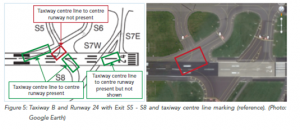
Bron: Report ‘Misaligned take off’ by OVV
Study
20JUN2019Planning
Implementation
30SEP2019Evaluation
31DEC202336, 25, -
-
32. Southern departures on runway 18C (Zwanenburgbaan)
ISMS partners jointly investigated a runway incursion in which an aircraft was cleared to enter the Zwanenburgbaan (Runway 18C), while another aircraft had permission to depart to the south. The study brought a number of measures to light which may further reduce the risk of incorrect line-ups. For example, the sight lines from the Control Tower may be improved. We have also conducted further research into the ways of working and operational procedures when taking-off from the Zwanenburgbaan Runway (18C).
The initial proposals for potential risk reducing actions indicated four areas to be investigated as improvements in these areas might bring safety benefits. Result of the evaluation is that these investigations have indeed been executed and led to several operational risk reducing measures.
Study
28NOV2019Planning
Implementation
31OCT2020Evaluation
03FEB202536, 25, -
33. Reduce risk of ground collision between two aircraft in pushback
On February 15 and July 9, 2019, two aircraft had a collision during a pushback manoeuvre. ISMS partners jointly investigated these pushback accidents.
The task force has implemented four measures which prevent pushback accidents. The long pushback procedure was refined and the responsibilities of the ground controllers and the pushback drivers were clarified. There are fixed pushback and release points on taxiway Alpha and for non-standard pushback clearances. This measure was evaluated in 2024, which showed that all underlying actions were correctly implemented and effective.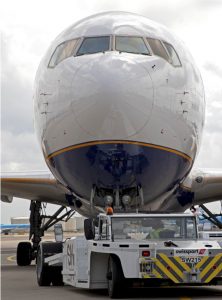 Study
Study
02OCT2020Planning
Implementation
31JUL2021Evaluation
27MAY202436, 25, -
34. Uniform platform extension from 9 to 12 parking positions
The Uniform platform was expanded from 5 to 9 parking spaces by Schiphol and its partners. Three additional parking spaces have been created for wide body aircraft. This reduces bottlenecks in parking spot allocation and relieves gate planning, which thereby reduces the risk of on-ground safety incidents. In addition, aircraft will be serviced at the total of 12 parking spots. That means they will cross the Aalsmeerbaan Runway (18L/36R) less frequently, thereby reducing the risk of runway incursions.
Study
Planning
26MAR2018Implementation
31MAR2020Evaluation
26MAY202536, 25, -
-
35. Safety net for take-off and landing from a runway which is not in use.
Air Traffic Control the Netherlands (LVNL) has created an extra safety net so that air traffic controllers receive a digital warning if they want to use a runway that is not currently in use. An additional warning will follow if the air traffic controller then gives permission to take off or land on that runway. These warnings prevent planes from taking off or landing on runways that are not in use. This measure was evaluated in 2023, which showed that it was correctly implemented and effective.
Study
Planning
Implementation
01MAR2020Evaluation
31DEC202336, 25, -
37. Attempted taxiway take-off
On 6 September 2019 an aircraft attempted to take off from a taxiway instead of the Zwanenburg Runway. A number of measures to prevent this from occurring again were immediately implemented. For example, the standard night taxi route has been changed and the location has been identified as a hotspot where pilots and air traffic controllers are required to be extra alert. The markings that guide pilots towards the runway have also been made clearer and new lightings at runway entries, Runway Guard Lights, have been implemented. Lastly, awareness programs for flight crew and ground controllers are launched.
This measure was evaluated in 2023, which showed that all underlying actions were correctly implemented and effective. No more comparable incidents have taken place since.
Study
20MAY2020Planning
Implementation
30JUN2022Evaluation
31DEC202336, 25, -
51. Reduction of ground vehicle movements from and to buffer positions
The G-buffer is increasingly used for handling aircraft. In the spring of 2024, the remote buffer positions G73, G76 and G79 were renewed. Part of this renewal was the introduction of a fixed connection to the fuel system. This means that tankers no longer have to drive to these buffer positions. This is likely to reduce the risk of on-ground safety occurrences.
Study
Planning
Implementation
26APR2024Evaluation
09MAY202536, 25,


 Back to introduction